
VIN vs. Nameplate: How El Paso Drivers ID Car Keys
Your car's VIN, not the nameplate or where you bought it, determines your key and transponder. Here's how El Paso drivers verify it before calling anyone.
The only reliable way to confirm your car’s exact key or transponder is to decode the VIN through official channels, not the nameplate, trim badge, or where the car was bought. The VIN identifies the vehicle. A locksmith or dealer then matches it to the correct key.
We hear a version of the same question every week, from pickup lines on North Mesa to driveways in Horizon City: the trim badge says one thing, a cousin’s identical-looking car needs a different key, and nobody can explain why. The badge was never built to answer that question. The VIN was.
How Do You Verify What Key or Transponder Your Car Needs?
The only reliable method is decoding your vehicle’s VIN and having a locksmith or dealer match that vehicle to the correct key and transponder using licensed parts lookup systems the public cannot access. The nameplate, trim badge, and where you bought the car are not reliable indicators of what key it takes. A VIN decode confirms the vehicle itself: year, make, model, plant. It does not hand you the exact key spec on its own.
That two-step split, VIN for the vehicle, professional lookup for the key, is the whole idea behind this post. Most of the confusion we run into on calls comes from skipping straight from “what does my car look like” to “what key does it need,” without the step in between where someone with the right database actually checks. Here is what that two-step process looks like in practice.
- 1
Locate your VIN
Find the 17-character VIN on the vehicle or its paperwork before you do anything else.
- 2
Run it through NHTSA's free decoder
Confirm the vehicle facts: year, make, model, and plant of manufacture, using the free public tool.
- 3
Note what the decoder does not tell you
It will not show a transponder chip type, remote FCC ID, or key blank. That is a separate lookup.
- 4
Call a locksmith or dealer parts desk with the VIN
They match the vehicle profile to the exact key and transponder using systems the public does not have.
Notice that nowhere in those four steps does a decoder hand you a key number. It hands you facts about the vehicle. The key match still needs a second, professional step, and that is true whether the car was bought new at a dealership on Airway or driven up from Juarez five years ago.
Why the Nameplate or Trim Badge on Your Car Cannot Be Trusted
A nameplate or trim badge reflects a marketing trim level chosen at the factory, not a manufacturing or key-system spec. Two cars wearing the same badge can carry different ignition or transponder hardware depending on options, model year, and which market the car was built for. The badge was never designed to answer a locksmith’s question.
Think about what a trim badge is actually for. It tells a shopper on a lot whether the car has leather seats or a sunroof. It says nothing about which immobilizer module is wired behind the dash or which transponder frequency the factory installed that production year. The factory can put the same trim badge on a car built in January and a car built in November of the same model year, and depending on a mid-year running change, those two cars can need different keys. The badge does not know that. The VIN does, once someone with the right lookup reads it correctly.
What a VIN Actually Encodes (And What It Doesn’t)
A VIN’s structure is defined in binding federal regulation, not industry habit. Under 49 CFR 565.15, positions 1 through 3 are the manufacturer identifier, positions 4 through 8 are vehicle attributes, position 9 is a check digit, and positions 10 through 17 cover the model year, plant, and production sequence. Nowhere in that structure does the VIN carry a transponder chip type, remote FCC ID, or key blank code.

That is worth sitting with for a second. The federal government requires every manufacturer to build a VIN this exact way, so it is not a loose industry convention that varies by brand. It is a fixed 17-character structure, checked by a math formula built into position 9, and every VIN issued for the US market follows it. What it was never designed to do is carry key data. That gap is not a flaw. It just means a VIN decode and a key lookup are two different questions, answered by two different systems.
Where to Physically Find Your Vehicle’s VIN
You can find your VIN in three common places without any special tool: through the base of the windshield on the driver’s side, on a sticker inside the driver’s door jamb, and printed on your registration, insurance card, or title. Any one of these gets you the full 17-character string.

If you are standing outside your car right now, the windshield plate is usually the fastest of the three. Stand at the driver’s side corner of the dashboard and look down through the glass. If the sun glare makes that hard in the middle of an El Paso afternoon, the door jamb sticker works just as well, and it is shaded. Either one gives you the same 17 characters you would find on your insurance card.
What NHTSA’s Free VIN Decoder Can and Cannot Tell You
NHTSA’s free public vPIC decoder reliably returns make, model, model year, plant city, and plant country from a VIN, and sometimes trim. Out of its full catalog of 144 data fields, only one touches keys or ignition at all: a Keyless Ignition flag, and it is populated for some vehicles only, not every one. There is no vPIC field for transponder chip type, frequency, or key blank.
| What a Free VIN Decode Shows | What Only a Professional Lookup Adds | |
|---|---|---|
| Make, model, year | Confirmed directly from the VIN | Same facts, used to pull the correct parts catalog |
| Plant country | Confirmed directly from the VIN | Already settled, no second check needed |
| Destination market | Field exists in the schema, rarely returns a value | Not resolved by this field either; a lookup does not depend on it |
| Transponder chip, FCC ID, key blank | No field exists at all | Matched from the vehicle profile using licensed parts databases |
You can run this decode yourself in under a minute at NHTSA’s own vPIC decoder, and we would rather you do that before calling anyone. It is free, it is the real government tool, and it will confirm the vehicle facts. Just do not expect it to hand you a key number when it finishes. That last column in the table above is the part a public tool was never built to do.
El Paso Is a Border City: Why That Makes the Badge Even Less Reliable
El Paso is a border city where a real, if unquantified, share of locally driven vehicles were originally purchased in Mexico’s domestic market rather than at a US dealer. That means the nameplate or the country a car was bought in tells you even less here than elsewhere. It does not mean Mexico-built cars need different keys as a rule. Purchase history simply cannot substitute for a VIN-based check.
We are not going to tell you a specific make or model has a different Mexico-market key, because we have not found a source that ties any current vehicle to that claim, and we are not going to invent one. What we will say is that a border city sees more of this exact confusion than most places: a car bought new across the bridge, a family sedan that moved north with a household, a used car with a title history that skips a state entirely. None of that history tells a locksmith what key the car needs. The VIN, checked properly, does.
The “Destination Market” Field Exists, But Do Not Expect It to Populate
NHTSA’s vPIC schema does define a Destination Market field, described in NHTSA’s own data dictionary as the market where the vehicle is intended to be sold. Live testing this month found that field blank across every VIN checked, including a correctly decoded Mexico-built Volkswagen VIN and two US-built VINs. A reader should not expect this field to return a usable result, even though the concept behind it is real.
Destination Market is a real field in NHTSA’s own schema. It almost never comes back populated, so do not expect your own VIN check to confirm it.
We tested this directly rather than repeat something we could not verify. A Mexico-built VIN decoded cleanly and correctly returned Mexico as the plant country, which is a different, separate fact that does reliably show up. The destination field next to it came back empty every time, regardless of where the car was built. That is worth knowing before you go looking for it yourself and find nothing.
Fort Bliss and PCS Households: The Same Problem, a Different Cause
Fort Bliss households arriving with vehicles titled or purchased out of state or out of country face the identical verification problem for a different reason: an unfamiliar vehicle history rather than a border purchase. The fix is the same either way. Check the VIN through official channels rather than assuming the paperwork, plates, or badge tell the full story.
A car that PCS’d in from a duty station three states away can carry the same badge-versus-key confusion as a car bought across the border, just for a different reason. Nobody handed you the vehicle’s key history when you moved, and the plates or the paperwork from another state will not fill that gap either. Our Fort Bliss service page covers what else is different about a PCS move for keys and locks, but the VIN check itself works exactly the same way it does for anyone else in El Paso.
How to Tell Which of the Four Key Types Your Car Uses
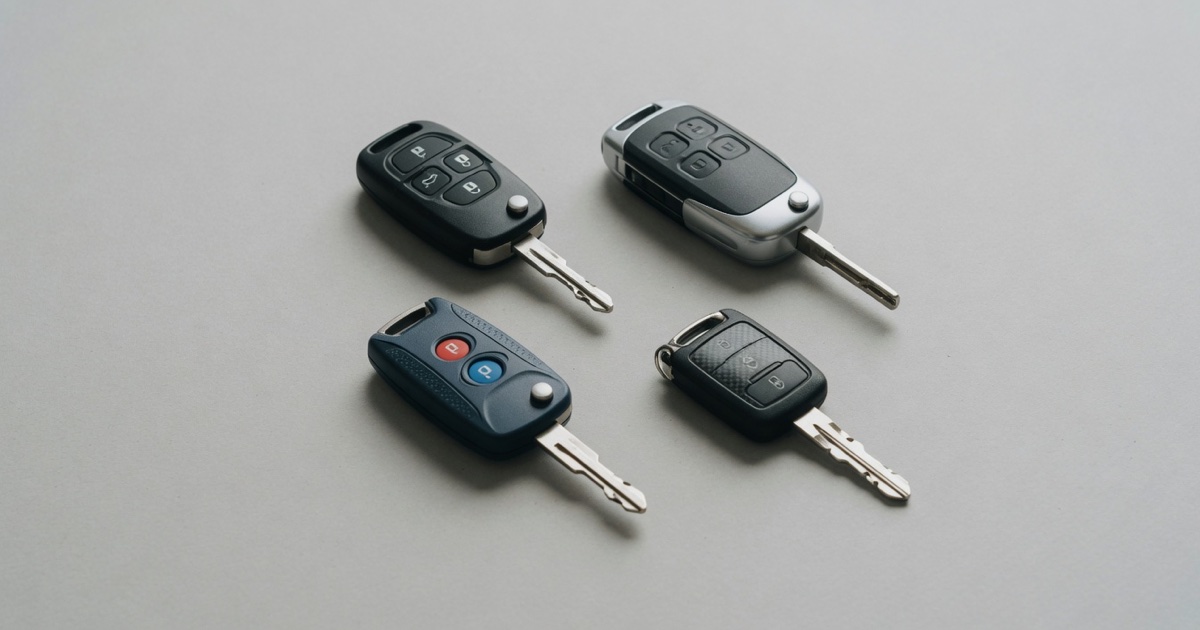
Car keys fall into four observable categories. A basic mechanical key carries no chip. A transponder key looks like an ordinary metal key but has a chip in the head. A remote head key combines a blade with a built-in lock and unlock remote. A proximity or smart key, used with push-button start, is never inserted into the vehicle at all. Look at the key in your hand and match it to these four shapes.

A transponder key will still turn the ignition cylinder even if the chip is bad or unprogrammed, which is exactly the trap that trips people up. A remote head key is a metal blade attached to a plastic head full of buttons. On some models the blade folds into the head like a switchblade, and on others it is fixed. If your key never touches a slot at all and the car starts with a button while the fob sits in your pocket or purse, you are holding a proximity key, and our proximity and smart key page and our push-button start fob page both go deeper on what that means for service.
Why a Key That Turns But Won’t Start the Car Means a Transponder Mismatch
A key that turns the ignition cylinder but does not start the engine is the classic sign of an immobilizer or transponder mismatch, not a cutting problem. The vehicle’s security module checks the chip’s code separately from the mechanical cut and blocks the engine if the two do not match. A correctly cut key can still fail this electronic handshake.
A key can turn perfectly and the car still will not start. That is the chip talking to the car, not the metal.
This is one of the most common mix-ups we get called out for. Someone assumes a key that turns but does not start the car means the ignition cylinder itself is failing, and they start looking at the mechanical parts. Far more often than not, the cylinder is fine. The chip in the key head and the car’s immobilizer module are simply not agreeing, and that disagreement has nothing to do with how well the blade was cut.
Did Your Car Come With an Immobilizer? A Quick, Honest History
The United States has no federal immobilizer requirement, unlike Canada, which began requiring them in 2007. US adoption was voluntary and manufacturer-driven, but it moved fast anyway. According to insurance industry loss data, immobilizers were standard on 62 percent of non-Hyundai and non-Kia US models by model year 2000, and 96 percent by 2015. Most cars on the road today have one even without a law requiring it.
That is a more honest answer than picking one year and calling it “when chip keys started.” There was no single year. Adoption climbed steadily through the late 1990s and 2000s as manufacturers added the technology on their own, ahead of any regulation forcing them to. By the time most of the sedans and trucks common on El Paso streets today were built, an immobilizer chip in the key was already the norm, not the exception, which is exactly why a transponder mismatch is such a common call for us.
What Happens If Every Key to Your Car Is Lost
When every key is lost, a locksmith or dealer generally has to decode the lock cylinder or originate a new key from the vehicle’s identity rather than duplicate an existing key. Proof of ownership, a photo ID plus registration, insurance card, or bill of sale, is required before that work starts. This is the scenario where VIN-based identification matters most, since there is no working key left to reference.
There is no shortcut here, and there should not be one. If a locksmith can originate a key for your car without asking who you are and whether you own it, that same locksmith can do it for anyone standing next to any car. Have your VIN, your ID, and one proof of ownership ready before you call, and the whole process moves faster. Our key replacement service page covers what that process looks like once the VIN and ownership are both confirmed.
How to Verify a Texas Locksmith Is Actually Licensed
Texas locksmiths are licensed through the Department of Public Safety’s Private Security Bureau. The public can look up an individual or company license through the state’s Texas Online Private Security portal. Our own license, Texas B19847, is one example you can check the same way. Checking this before any vehicle work begins is a reasonable step, alongside asking for identification and an estimate, ideally written, before work starts, per general consumer protection guidance. For Spanish-speaking family members, our guide in Spanish on choosing a trustworthy car locksmith walks through the same checks, including what Texas rules require on company vans and ads.
The national trade association’s own consumer guidance flags a red flag worth knowing before you call anyone: a locksmith who skips non-destructive methods and reaches straight for a drill, or who quotes one price on the phone and a much higher price on arrival, is not following standard, reputable practice. None of that is specific to key and transponder work, but it is worth checking the same way you would check any other locksmith call.
What to Do Once You Know Your Key Type
Once you have your VIN and a general sense of your key type, call a locksmith or dealer parts desk with that information so they can confirm the exact match. Never text a photo of your VIN or the number itself since this line cannot receive SMS. From there, replacement, fob programming, or proximity key service follows its own process, and cost questions are answered on our pricing page and cost guide, not here.
Once you have your VIN written down and a sense of which of the four key types you are holding, call us at (915) 799-0939 and have that information ready. We will confirm the exact key and transponder match through our car key and fob replacement service. If your next question is what it costs, our car key and fob replacement cost guide and pricing page cover that in detail, and if you are locked out of the car while you sort any of this out, our lockout service cost guide walks through that separate problem.
If your key already turns the lock but the remote buttons have gone quiet, read our guide to a dead key fob battery versus a dead fob before assuming the fob needs replacing.
Quick Recap: VIN First, Never the Badge
The badge, the trim level, and the country a car was purchased in are not reliable ways to identify a key or transponder. The VIN is. Locate the VIN, decode it for the vehicle facts, then let a locksmith or dealer match that vehicle to the exact key using professional lookup tools. Treat anything else as a guess.
That is the whole method, and it works the same whether your car came from a lot on Airway, a dealership across the river, or a driveway in Fort Bliss housing you just moved into. Find the VIN, confirm the vehicle facts, then let a professional match the key. If your car’s lock or door hardware is giving you trouble too, not just the key, our post on why door locks stick in El Paso summer heat covers that separate problem.
Common questions
How do I know what key or transponder my car needs?
Decode your VIN and have a locksmith or dealer match that vehicle to the correct key and transponder using licensed parts lookup systems the public cannot access. The nameplate, the trim badge, and where you bought the car are not reliable indicators. A VIN decode confirms the vehicle itself, not the exact key spec.
Can I use a free VIN decoder to find my transponder type?
No. NHTSA's free public vPIC decoder reliably returns make, model, year, and plant country, and sometimes trim, but out of 144 data fields only one touches keys at all, and it is not populated for every vehicle. There is no field for transponder chip type, frequency, or key blank.
Will a VIN check show me if my car is a Mexico-market vehicle?
Not in practice. NHTSA's schema defines a Destination Market field, but live testing found it blank across every VIN checked, including a Mexico-built Volkswagen and two US-built vehicles. Rely on a professional lookup instead of expecting this field to return a usable result.
How can I tell which of the four key types I have?
Look at the key itself. A basic key has no chip. A transponder key looks ordinary but has a chip in the head. A remote head key combines a blade with a built-in remote. A proximity or smart key is never inserted into the car at all.
Is a key that turns but will not start a cutting problem or a chip problem?
It is a chip problem, not a cutting problem. That is the classic sign of an immobilizer or transponder mismatch. The vehicle's security module checks the chip's code separately from the mechanical cut and blocks the engine if the two do not match, even with a correctly cut key.
How do I check that a Texas locksmith is actually licensed?
Texas locksmiths are licensed through the Department of Public Safety's Private Security Bureau. Look up an individual or company license through the state's Texas Online Private Security portal before any vehicle work begins, and ask for photo ID on arrival too.
Locked out, or need a lock changed?
We are mobile across El Paso around the clock, with a 20-minute average response and upfront pricing before any work starts.
Call Now: (915) 799-0939