
Locked Out of Your House in El Paso? Do This First
Locked out of your house in El Paso? A calm first-steps guide: other doors, spare keys, calling your landlord, and when to call a locksmith.
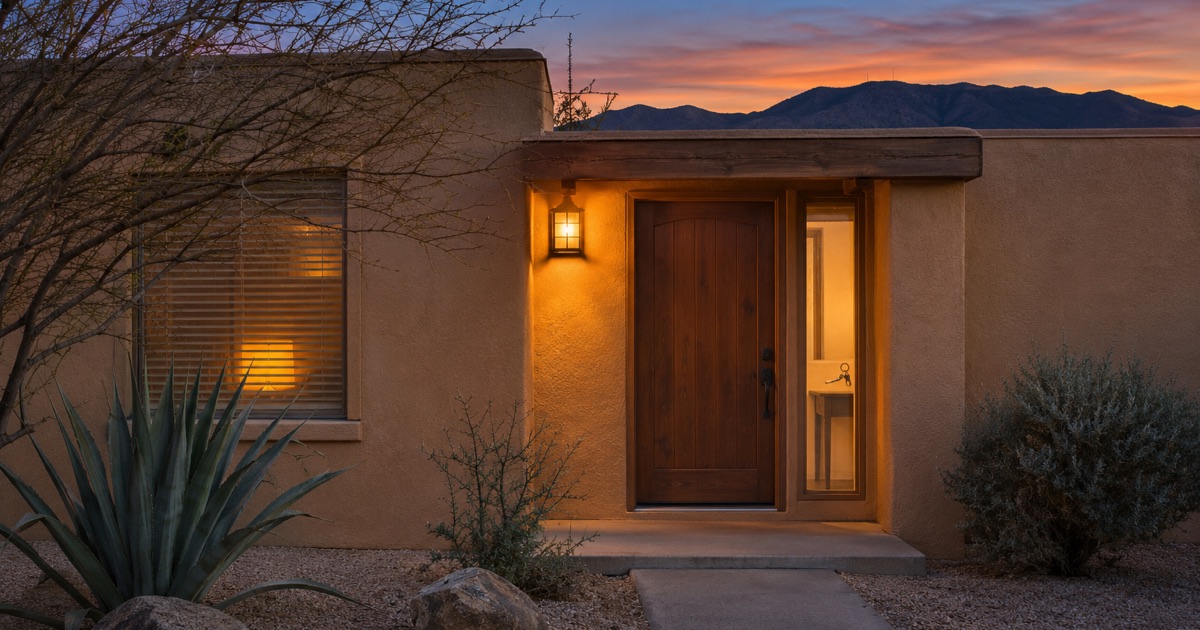
The door clicks shut behind you in a Lower Valley driveway, and your keys are sitting on the kitchen counter. It is November, the sun is gone by six, and the porch light is the only thing on. Your phone is in your hand and your stomach has already dropped.
If you are locked out of your house, stay calm, check that nobody inside needs help, walk to every other door you own, and ask whoever holds a spare key, such as a roommate, neighbor, relative or landlord. If none of that gets you in, call a licensed locksmith and tell them which door and what kind of lock.
This guide covers the first few minutes and the visit itself. Nothing here teaches you how to get past a lock, and we would not post that anyway. You get the order of steps, what to leave alone, and what to expect if you do end up calling us.
What Should You Do in the First Five Minutes of Being Locked Out?
Stop, step back from the door and breathe. Then work down a short list: make sure nobody inside needs help, walk to every other door you can reach, think about who has a spare, and only then call a locksmith. Most house lockouts end in the first few of those steps, and none of them need force.
Panic makes people rattle the handle and pace the porch. Skip that. Take thirty seconds to picture the inside of the house. Is anyone home, a kid in a back room or an older parent napping? Is anything on the stove? Is a pet in trouble? Those answers decide whether this is a lockout or something more urgent.
If everyone inside is fine, the rest is a simple sequence. This is the whole thing in one picture, so you can follow it with a phone in one hand.
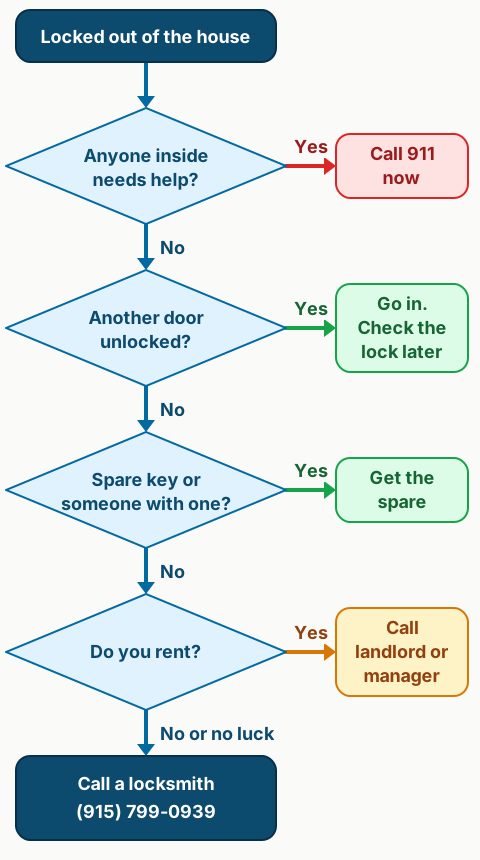
Notice what is missing from that picture: anything involving tools, windows or a running start at the door. If it is your car that is locked instead of your house, read this guide instead. The steps differ, mostly because of what can happen to someone sitting inside a hot car.
Which Other Doors and Entry Points Are Worth Checking?
Check every door you already have the right to use: the back door, a side door, a sliding patio door and the door from the garage into the house. People forget these more than any other step. Try the handle, not the lock. If one is unlocked, you are in and the problem is solved without a call.
In El Paso homes that is often more doors than you would guess. Many single-family houses have a back door onto the patio, a sliding door off the kitchen and a garage entry that nobody has locked since the day they moved in. Walk the whole outside of the house, slowly, and try each one. A door you meant to lock and forgot is the best news you can get this evening.
Apartment and townhome residents have fewer options, but check the balcony slider and any shared breezeway door that is yours to use. If a neighbor’s door or a fence is not yours, leave it alone.
What about windows? Use judgment here. Do not break glass, do not climb on anything unsafe, and do not force a frame. A window that happens to be open is not an invitation to take a fall, and a cut hand or a twisted ankle is a worse evening than waiting a while for a spare key. If you can reach a window safely from the ground and it is already unlocked, that is one thing. Anything past that, stop and move to the next step.
Who Might Be Holding a Spare Key?
A spare with a person you trust is usually the quickest way back in once the doors are checked: a roommate, a relative, a neighbor, a house sitter or a partner at work. Many El Paso households have family nearby, so make that call before any other. If you still have to wait, ask them to bring it rather than hunting for a hidden one.
Think through the list out loud. Who watered your plants last time you traveled? Which cousin or in-law lives ten minutes away? Does the neighbor across the street have a key from the last time you were out of town? One phone call usually settles it, and the trip takes less time than most people expect.
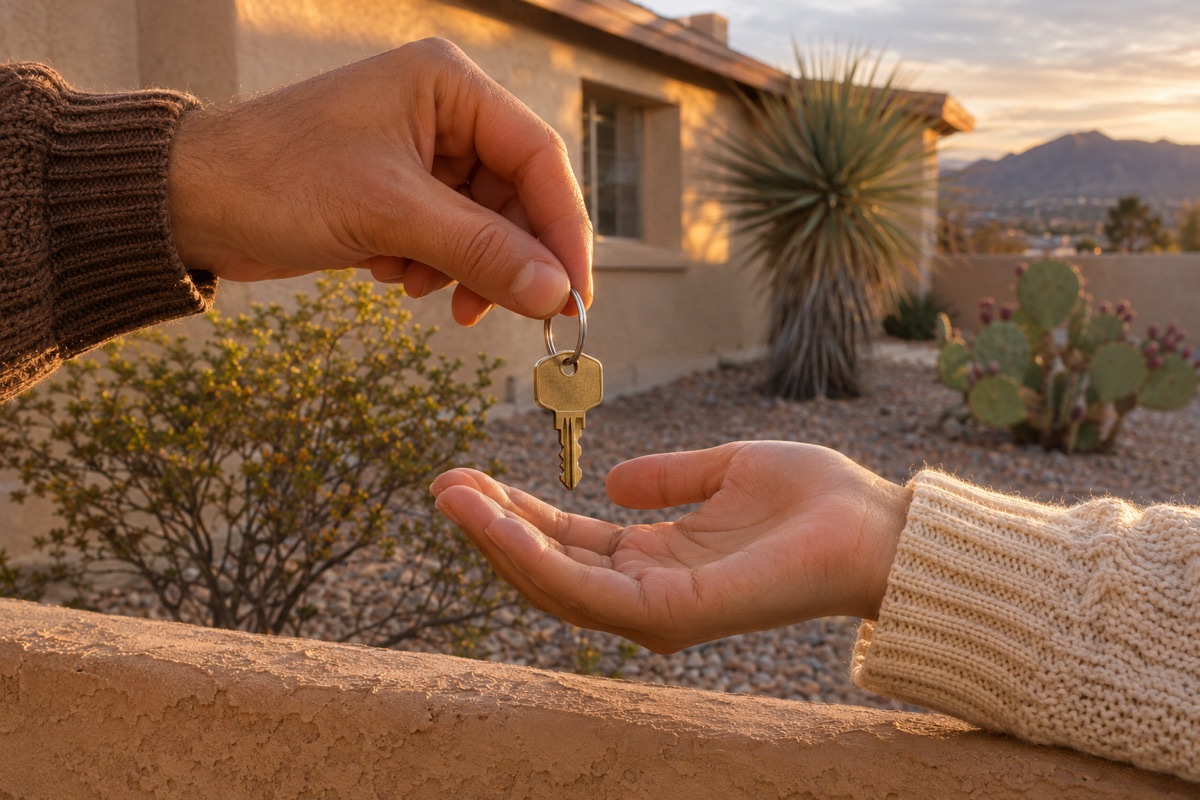
The safest place for a spare key is in a person’s pocket, not under your doormat.
AAA’s advice on hiding a house key says the same thing in more words. Thieves look under the mat no matter how obvious the spot, rocks and flowerpots get checked, door and window ledges get felt along, and a mailbox is about as welcoming as a sign that says “key here.” AAA names a family member, friend or neighbor as the safest place for a backup, and it adds that a keypad code lock is not foolproof either.
So if you have been meaning to tuck a key somewhere outside, give it to someone you trust instead. You will thank yourself the next time the door shuts.
Renting? Who Should You Call Before a Locksmith?
If you rent, call your landlord or property manager first. They often keep a key or can send someone with one, and they know whether your door has been rekeyed recently. A locksmith is a good backup, but the person who manages the building can tell you whether a key is on the way and whether a lock change is planned.
Say your unit number and which door you are at. Ask whether someone can bring a key and roughly when, and ask when the locks were last rekeyed. If you live in an apartment near UTEP or out in the Northeast, the leasing office or maintenance team may hold a master or office key. We say “may” because every property handles this differently, and some do not keep keys on site at all.
A little law is worth knowing, in plain terms. Texas law limits when a landlord can lock a tenant out, and a landlord who changed the locks must give you a key. In Texas, a landlord is also generally required to rekey the locks within seven days after a tenant turns over, so it is fair to ask your manager when yours was last done. You can read the rules yourself in Chapter 92 of the Texas Property Code, which opens in a browser. This is not legal advice. It does not tell you that anyone has to open your door at a certain hour, so do not count on it.
Here is how the first moves differ.
| If you rent | If you own | |
|---|---|---|
| First call | The property manager or landlord, then a spare holder, then a locksmith | A spare holder, then a locksmith |
| Who may hold a key | The landlord, the manager's office or maintenance | You, a household member or a neighbor you trust |
| If the locks were changed on you | Texas law limits landlord lockouts and requires a key on request, so ask in writing | Not applicable |
| After the door opens | Ask the manager when the locks were last rekeyed and check your lease before changing hardware | Rekey or replace on your own schedule |
What Is Safe to Try Yourself, and What Is Not?
Try the handles, ask for a spare and call the manager. Do not force the door, break a window, climb up to an upper floor or take the lock apart. Those moves turn a ten-minute problem into a repair on the door, the frame or you. If a lock is going to be opened, a trained person should do it.
Safe means things that cost you nothing and risk nothing: checking every other door, windows you can see from the ground, calling people, looking for a spare, checking your smart lock app or the battery if the lock has one. That is the full list. Everything else carries a real chance of making the problem bigger.
Forcing a door turns a lockout into a repair. Waiting for the right person usually saves the frame.
A shoulder against the door might feel like action, but a split frame or a bent latch is a bigger job than the lockout you started with. The method for any lock depends on the lock, its condition and any damage already there, and that is not a call to make in the dark at a stressed moment. If the door or lock does get damaged, lock repair is the next step, and repair comes before anything else.
Could a Dead Keypad or Smart Lock Battery Be the Real Problem?
If your door has a keypad or smart lock, a dead battery may be the whole problem, not a lost key. Some of these locks have two small metal contacts on the outside where you touch a 9-volt battery for a moment and then enter your code. Not every model has them, so check your model’s manual or the maker’s support page.
Maker instructions vary. One Kwikset touchscreen model, for example, has 9-volt terminals under the screen, and you hold a battery to them while you enter a valid user code, then replace the batteries right away once you are inside. Other models, including some from other brands, work differently or have no outside contacts at all. A 9-volt battery alone does not open a lock either. You still need a valid code.
Many keyed models also keep a regular key cylinder as a backup, so a spare key may still work even when the screen is dark. The habit that saves the most trouble is simple: change the batteries when the lock first warns you, not after. If you are shopping for a lock that fits your household, see our smart lock installation service.
When Should You Call a Locksmith, and What Should You Say?
Call when the other doors are locked, nobody with a spare can reach you soon and no one inside needs help. Say the address or cross streets, which door you are at, whether it is a house, apartment or townhome, what kind of lock it is if you know, and whether a spare or landlord is still in play. A phone call is all it takes.
Have your ID ready, with your address if it shows one, or a lease or a utility bill, so the technician can confirm you live there. That is the usual idea for a house lockout, and a photo of the document on your phone works if the paper is inside.
Our emergency lockout service covers lost house keys, doors that closed behind you, and broken door locks, including nights, weekends and holidays. It also covers apartment door entry, mailbox lockouts and gate access. We tell you up front that the method depends on the lock, its condition and any existing damage, and we give you a clear quote before we start work.
Cost questions are fair, and we keep them out of this guide on purpose so the numbers stay current in one place. See what a lockout call costs for the full picture, or check the pricing page. Prefer Spanish? Our guide Cerrajero a domicilio en El Paso walks through a home visit step by step.
How Does a House Lockout Visit Go, Step by Step?
The visit is short and predictable: the technician confirms who you are and that you live there, looks at the door and the lock, tells you the plan, opens the door, and you check that the lock still works before they leave. Nothing in that order is a mystery, and none of it should start before you are told the total.
FTC guidance says a legitimate locksmith should confirm your identity and make sure you are the property owner before doing any work. If you rent, expect the same idea with a lease or similar proof. Some legitimate locksmiths are mobile with no storefront, so a missing shop is not a warning sign by itself.
- 1
The company name matches the one you called
Look at the vehicle, the business card or the paperwork.
- 2
You confirm who you are and that you live there
An ID, a lease or a utility bill is the usual idea.
- 3
The technician looks at the door and tells you the plan
The method depends on the lock and its condition.
- 4
The door opens and you test the lock
Try the key, the latch and the deadbolt before the technician leaves.
- 5
You get the paperwork and the total you were told
You will be informed of any price changes before work proceeds. Ask your questions before they leave.
ALOA, the locksmith trade association, says non-destructive entry should come first, and that a company that immediately goes to drilling is often a sign of a scammer. We are not saying drilling is never needed. We are saying it should not be the opening move on a house door. Read ALOA’s guide to spotting a scammer for their full list, and see how to judge a provider before you book for the longer checklist.
Should You Rekey or Change the Locks After a Lockout?
If your keys are lost, or you moved in and never changed the locks, now is a good moment to ask. Rekeying changes which keys work so old ones stop opening the door, and it works when the hardware is in good shape. If the lock or door was damaged or forced, repair comes first, then the rekey.
ALOA recommends rekeying as soon as possible after you take possession of a property, and changing the locks on an apartment when you move in. That makes sense, because you never know how many copies of the old key are floating around. ALOA’s advice is about moving in, and the logic carries over to a lost key: if a key is out there and you do not know where, a rekey puts the old one out of use. Our lock rekeying page covers the details, and ALOA has a plain guide to changing or rekeying locks.
A home lockout is an access problem and may not need a new lock at all. Rekey is the move when the key itself is the concern. If the deadbolt is worn or weak, deadbolt installation may be a better fit, and the same goes for a lock that felt stiff before you were locked out. For that, read why door locks stick in an El Paso summer. To see what else a technician can handle on site, read what else a mobile locksmith can do on site.
Does Your Kind of Home or Neighborhood Change the Plan?
The steps are the same, but the doors differ. A Lower Valley or Horizon City single-family door, an older Sunset Heights or Kern Place home with original hardware, an apartment near UTEP or in the Northeast with an on-site office, and a Fort Bliss or off-post rental all change who to call first and what the lock looks like.
A single-family house usually means a spare with family or a neighbor and a few other doors to try. An older home may have hardware that has seen decades of use, which is one more reason to describe the lock when you call. An apartment adds a manager to the list. Fort Bliss families and anyone in off-post housing often deal with unfamiliar doors after a move, and lease turnover keeps that steady.
November adds its own habits. Evenings in El Paso are cool, with a normal overnight low around 41 F for the month, and it gets dark early. Holiday visitors and house sitters do not always carry a key, so a quick check on who has one is worth a minute. If you want a technician who handles the full range, see our residential locksmith service.
Ready to Get Back Into Your Home?
If the other doors are locked, nobody with a spare can reach you and no one inside needs help, call Mobile Locksmith Pros at (915) 799-0939 and say which door and what kind of lock. We handle house, apartment and townhome lockouts at any hour, and we will tell you the plan before work starts.
We hold Texas locksmith license B19847, and we have served El Paso since 2014. You can look up any Texas locksmith yourself through the Texas DPS Private Security Program lookup. Our average response is about 20 minutes, and that is an average, not a promise: actual arrival varies by location, traffic and call volume.
When you are ready, call us or use our contact page.
Common questions
Should I call 911 if I am locked out of my house?
Only if someone inside needs help, or you smell gas or smoke. That means a child, an older relative, someone unwell, a pet in distress, or a stove left on. For a plain lockout with nobody in danger, start with a spare key holder, your landlord or a licensed locksmith.
Who should I call first if I am locked out of a rental?
Call your landlord or property manager first, since they may hold a key or can send someone who does. Texas law limits when a landlord can lock a tenant out, and a landlord who changed the locks must give you a key on request. This is general information, not legal advice.
Will a locksmith need proof that I live here?
Yes, expect to be asked. A legitimate locksmith confirms who you are and that you are authorized to be at the property before work starts. An ID showing the address, a lease or a recent utility bill is the usual idea. Keep one of those handy, or a photo of it on your phone.
Should I rekey the locks after losing my house keys?
It is worth asking about. Rekeying changes which keys work, so a lost key stops opening the door, and it fits when the hardware is in good shape. If the lock or door is damaged, repair comes first. If you moved in and never changed the locks, a lockout is a good moment to raise it.
Is hiding a spare key outside a good idea?
Usually not. AAA warns that thieves check under the mat, rocks, flowerpots, door ledges and the mailbox, because those are the obvious spots. The safer backup is a spare held by a person you trust, such as a family member, a friend or a neighbor, who can bring it when you call.
Locked out, or need a lock changed?
We are mobile across El Paso around the clock, with a 20-minute average response and upfront pricing before any work starts.
Call Now: (915) 799-0939