
Car Key Copy, Cut or Program in El Paso: Which One?
A car key can be copied, cut from a code or programmed to the car. Here is what each job is, how to tell which you need, and what to bring in El Paso.
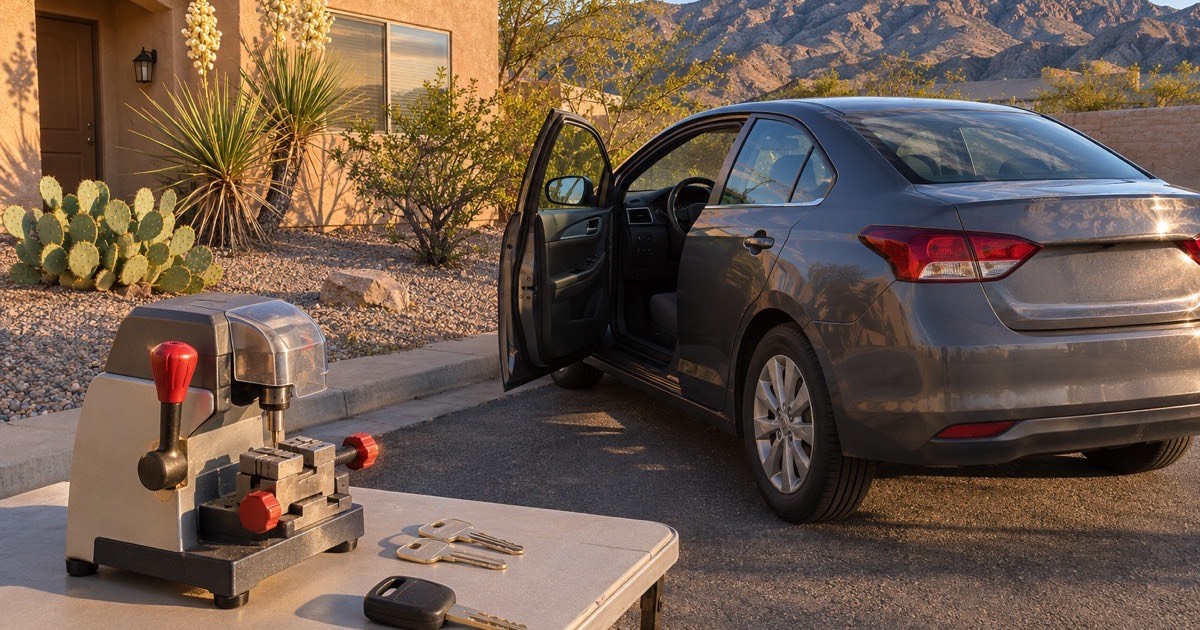
The spare car key lives in a kitchen drawer in a Northeast El Paso house, somewhere between the batteries and a takeout menu. Or it lives at the other duty station, because a Fort Bliss household split its keys during the move. Either way, a holiday road trip is coming and someone just said, “We should get a second key.”
A car key job is one of three things: a copy, where an existing key is read and duplicated; a cut from code, where there is no key to copy and the blade is made from the car’s key code; or programming, where the key is registered with the car’s computer. A chip key often needs more than one.
This guide covers the three jobs and how to pick the right one. Finding your key type from the VIN and the money side each have their own guide, linked further down. Here we stick to what each job is and what to expect.
What Is the Difference Between Copying, Cutting and Programming a Car Key?
Copying reads an existing key and makes a duplicate. Cutting from code makes a blade from the car’s key code when there is no key to read. Programming registers the key with the car’s computer so the engine will start. A plain metal key needs only the cut. A chip key usually needs the cut and the programming.
Those three words get mixed up all the time, even by people who work around cars. A shop might say “we cut keys” and mean a metal blade only. That is fine for a house key and often not enough for a car, because many car keys carry a small chip that talks to the car. Without the right chip, a key can turn the ignition and still not start the engine.
Here is how the jobs line up. Note that this table is sorted by the job, not by the kind of key you carry.
| Copy or clone | Cut from code, then program | |
|---|---|---|
| What it is | An existing key is read and duplicated. A chip may be cloned or a new key programmed. | No key to read. The blade is made from the car's key code, then the key is registered with the car. |
| What you need to start | A working key, plus ID and proof the car is yours | ID and proof the car is yours, and the car itself |
| What it does for the chip | May copy the chip data, or may need a new chip programmed, depending on the car | The chip is a separate step, because the car has to learn the key |
| Done at the car? | Copying the blade does not need the car. Programming happens at the car. | Usually yes, since the car's computer has to be there |
Our key cutting service covers the blade side of this. The chip side is the part that surprises people, and it is why a “quick copy” is not always quick or complete.
Which Job Does Your Car Key Need?
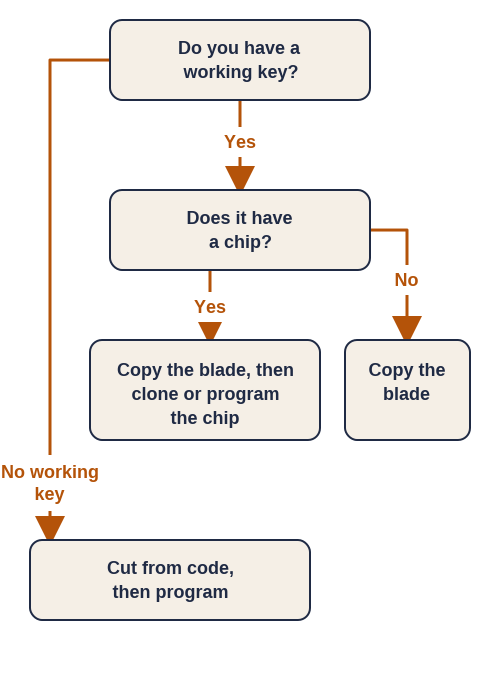
Start with what you have in hand. A working key means a copy or clone is possible. No key means the blade is cut from a code and then programmed. A key that turns in the ignition but will not start the car points to the chip, not the cutting.
Think of it as two questions. First, do you have a key that works right now? Second, does that key have a chip? A plain metal key with no chip is the simplest case. Many modern car keys carry a chip, so the answer to the second question is often yes. If you want to confirm yours, read how to find your key type from the VIN before you call.
The picture below shows the whole decision on one page.
One more thing before you pick up the phone. If the problem is a fob that stopped working, rather than a key you need made, check the battery first. The battery or replacement post walks through that.
Can a Locksmith Copy a Car Key When You Still Have One?
Often yes. The locksmith reads the working key and cuts a duplicate blade. If the key has a chip, the chip may be cloned or a new key may be programmed, depending on the chip. Whether a chip can be cloned cannot be seen by looking at it. Laser-cut keys are milled, so they usually need compatible equipment and a chip step.
Plain metal keys are the easy case. A laser-cut key, sometimes called a sidewinder, has a milled blade. Those are cut on different machines than a basic kiosk key, and they usually carry a chip. Our laser-cut keys page covers that work. The trade association ALOA lists duplicate keys and replacement transponder fobs as locksmith work on its page about what a locksmith does, so this is ordinary territory for the trade.
Two words are worth separating here. A clone copies the chip’s data onto a new chip. A new programmed key gets registered with the car’s computer. Which route applies depends on the car and the chip, and the locksmith confirms it for your vehicle.
If you have been told that “any key can be duplicated in a minute,” do not count on it for a car key with a chip. The cut is the quick part. The chip is the part that needs thought.
What Does Cut From Code Mean, and When Is It Used?
Cut from code means making a key without a key to copy. The locksmith gets cutting data for the car, usually from industry databases after ownership is checked, and cuts the blade from it. The VIN alone is typically not enough, because the VIN identifies the car and the code relates to the cut. The new key is then programmed.
So the VIN and the key code are cousins, not twins. The VIN tells the locksmith which car it is. The code gives the cutting specs for the blade. When a code is not available, the lock itself may be decoded, which means reading the lock to work out the cuts. Either way, no key is copied, because there is nothing to copy.
Cutting the blade is only half of a chip key job.
There is a small upside to starting from a code. A key made from a code starts clean, while a copy of a worn key carries the wear along with it. ALOA’s page on common lock problems says duplicating keys from old or worn keys can create issues, and that a locksmith may need to generate an original key using a code for the lock. The same goes for any cut key: a worn copy of a copy can drift away from the original cuts.
Cut from code is the job when every key is lost, or when there was never a spare. It is also where proof of ownership matters most.
What Does Programming a Key Actually Do, and What Happens at the Car?
Programming teaches the car’s computer to accept the key. The chip in the key sends a code, and the engine only starts if the car recognizes it. That is why programming happens at the car: the car’s computer is what has to learn the key. Fobs and remotes are ordered for the vehicle’s model and year.
Think of the chip as a password. The cut blade gets the key into the ignition. The chip is what convinces the car’s immobilizer to let the engine run. If the password does not match, the engine will not start, even if the key turns. A car can store only a limited number of keys, and how the programming is done varies by vehicle. Some cars have on-board steps, and others need specialized equipment.
At our end, this is how the visit goes. These are the general steps, not a how-to.
- 1
Confirm the job
We ask what you have: a key, a fob, or nothing, and which car.
- 2
Verify ownership
Photo ID plus the registration or title.
- 3
Cut the blade if needed
A copy from a working key, or a cut from code if there is none.
- 4
Program the key to the car
The car's computer learns the new key.
- 5
Test everything
Start the car, lock and unlock, and try the spare.
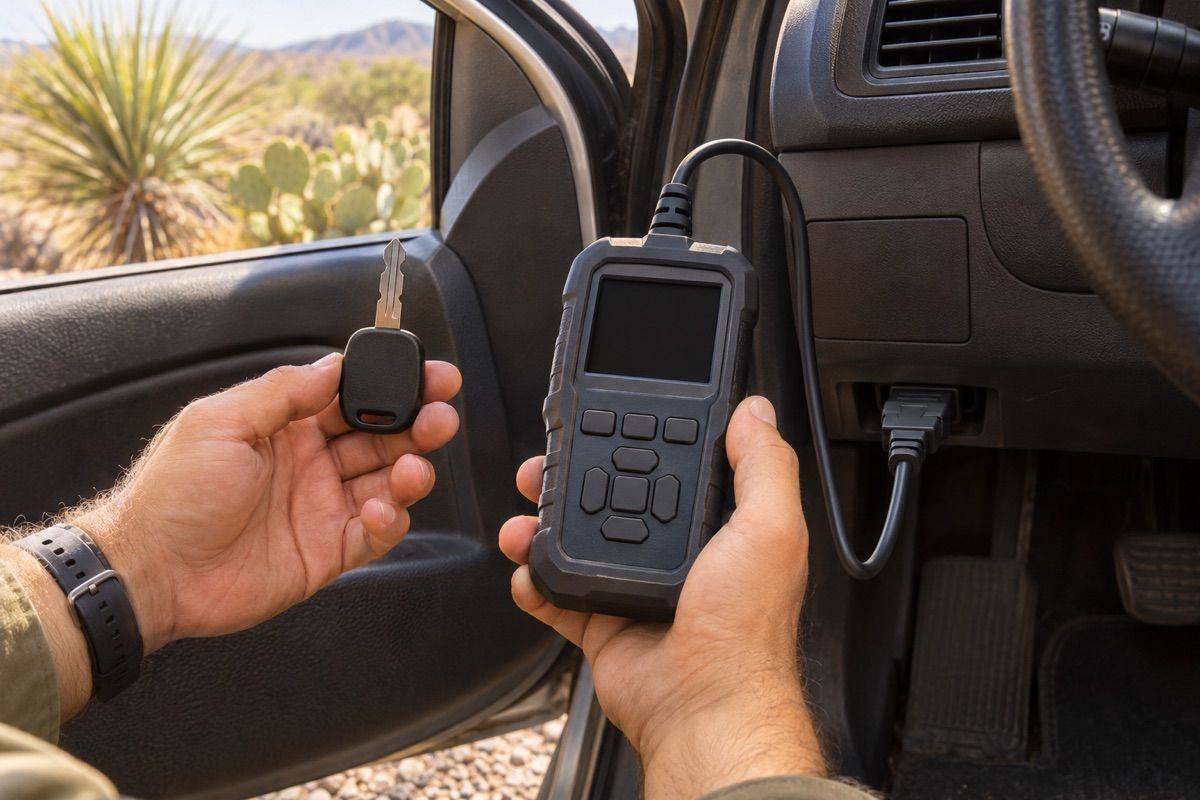
Our key replacement and programming service page is where to book this work, and the car key fob service covers remotes and smart keys. For the wider picture of what a mobile visit covers, see what a mobile visit covers. We cut and program at your location when the vehicle’s system is supported, and we confirm that by vehicle on the call.
What Should You Bring to a Car Key Job?
Bring a government photo ID, the registration (and the title if you have it), the car itself, and any key or fob you still have, even a broken one. The locksmith confirms what they accept when you call. A working key makes a copy possible, but it is not a requirement for every job.
That list is short on purpose. A photo ID shows who you are. The registration or title connects you to the car. The car has to be there because the key is registered to it. Bring a broken key or fob too, and let the locksmith decide whether it helps.
If you are in a household where one spouse is on the registration and the other is the one standing at the car, say so on the phone. That can happen in a Fort Bliss household after a move. The locksmith can tell you what paperwork to have ready before the visit, which beats finding out in the parking lot.
A few other small things help. Know the make, model and year, and keep the car in an easy place to reach. If you have more than one key or fob for the car, bring them all.
Why Will a Locksmith Ask for Proof the Car Is Yours?
A locksmith asks for proof of ownership because a key that starts the car is a key to the car. The industry’s access system for vehicle security functions, such as key programming, checks the technician’s identity and asks for proof of authority from the vehicle owner. A locksmith who asks for ID and registration is doing the job properly. One who does not deserves a second thought.
The industry’s own access system, set up through NASTF, is described as a structured verification and monitoring system meant to prevent misuse of vehicle security functions. It checks the identity and legitimacy of the technician and asks for proof of authority from the vehicle owner. The question you get at your car door comes from the same idea.
This is not about suspicion. A car is expensive, and a stolen car with a fresh key is a hard problem to undo. If you want to check that the person you call is licensed, the Texas DPS licensed locksmith lookup is the place to look.
When Is the Dealer the Only Option?
The dealer is the only option for some vehicles, most often European makes. Others allow a locksmith to do the job with the right equipment and access. It depends on the car, so a locksmith can tell you after you give the make, model and year, and you can ask what the dealer would need too.
ALOA says as much on its auto locks guide: in some cases, the dealership will be the only option for key issues. The same page notes that many manufacturers include some on-board programming for key fobs and immobilizers, and that it varies by vehicle.
So the honest answer is that it depends. Some cars are open to a locksmith. Some are locked down to the dealer. A good locksmith will tell you which one you have, even when the answer sends you elsewhere.
If you live in a border city like El Paso, you may also own a car that came from somewhere else, so give the full make, model and year when you ask. We would rather say “that one goes to the dealer” than start a job we cannot finish.
Should You Get a Spare Before Every Key Is Lost?
Yes, if you can. Copying from a working key is the simpler job. When every key is lost, the key has to be made from a code or the lock, then programmed, which takes more steps. A spare made while you still have a key is the easy version of the same job.
ALOA’s auto locks guide says to call a locksmith if you would like additional keys to prevent an “all-keys lost” situation. That is the whole argument in one line.
Copy the key while you still have one.
A spare also gives you something to learn from. A working key gives the locksmith something to read, and it lets them clone or program a second one without starting from scratch. Without it, every step has to be rebuilt from the car’s data.
For the money side of each situation, the key fob replacement guide breaks it down. Here the point is steps and effort. A copy has fewer steps. An all-keys-lost job has more to do and more to verify.
Can the Job Be Done Where Your Car Is Parked in El Paso?
In many cases, yes. We cut and program transponder keys, smart keys and key fobs at your location when the vehicle’s system is supported, so there is no need to tow a car that has no working key. Coverage depends on the vehicle, so give the make, model, year and your street or nearest cross street when you call.
Where the car sits matters less than people think. An apartment lot near Cielo Vista, a work parking space, or a driveway in the Northeast are all ordinary places for this kind of visit. A visit to a car parked on post at Fort Bliss depends on current gate rules, so tell us that on the call. What matters is that the car is there, because the key is registered to it. If you do not have a working key, driving to a shop may not even be possible, which is the point of a mobile visit.
People search for “key copy near me” and find a kiosk at a grocery store. That works for a plain house key. For a car key with a chip, ask whether the shop can program the chip and whether they will come to the car. If the answer is no, the kiosk copy may be a blade that fits and a car that will not start.
Is It the Key, or Just the Fob Battery?
Check the battery first if a fob has stopped working. A weak battery can look like a failed fob, so a fresh one is the first thing to try. A fob can sometimes need reprogramming after a battery change or a drop. If a new battery changes nothing, then it is a key job.
AAA says that replacing a fob battery or dropping a fob can sometimes mean it needs to be reprogrammed, usually by a locksmith or dealer. That is worth knowing, and it is also worth keeping in proportion. Start with the battery.
Our battery or replacement guide goes deeper, and a key fob battery replacement is a simple job if that is all it takes. If the real problem is that the key is locked inside the car, that is a different call, covered in keys locked in the car.
How Do You Ask for the Right Job When You Call?
Say what you have and what you want: “I have one working key and want a spare,” or “I have no key.” Then give the make, model and year, and where the car is parked. Call Mobile Locksmith Pros at (915) 799-0939 and we will say which of the three jobs it is and confirm the total before starting.
You do not need to know the trade words. Just describe the situation. A working key and a spare request is usually a copy or clone. No key at all points to a cut from code and programming. A key that turns but will not start the car points to the chip.
We hold Texas locksmith license B19847 and have served El Paso since 2014. To book, call (915) 799-0939, use the key replacement and programming service page, or send a note through our contact page. Amounts are on the pricing page. If you are calling after dark, read what to check before hiring at night first.
Common questions
Can a locksmith copy a car key with a chip in it?
Often yes, when a working key exists. The chip may be cloned, or a new key may be programmed to the car, depending on the chip. Whether a chip can be cloned is not something you can see by looking at the key, so the locksmith confirms it for your car before any work starts.
Is a key cut from a code the same as a copy?
No. A copy needs a key to read. A cut from code is used when there is no key, and the blade is made from the car's key code, which usually comes from industry databases after ownership is verified. If the key has a chip, it still needs programming after the blade is cut.
Does the car have to be there for key programming?
Yes, in practice. Programming registers the key with the car's computer, so the work happens at the car. That is how our service is set up, and we confirm coverage for your vehicle on the call. Give us the make, model, year and where the car is parked.
What do I bring for a car key job?
Bring a government photo ID, the registration or title, the car, and any key or fob you still have, even a broken one. A locksmith tells you exactly what they accept when you call, so ask before you leave the house. A working key makes some jobs simpler but is not required for every job.
Will a locksmith make a car key without proof of ownership?
A careful locksmith should not. Expect to be asked for a photo ID and proof the car is yours, such as the registration or title, before a car key is made. The industry's own security access system is built around identity checks and proof of authority from the owner, so the question is part of the job. A locksmith who skips it deserves a second thought.
Locked out, or need a lock changed?
We are mobile across El Paso around the clock, with a 20-minute average response and upfront pricing before any work starts.
Call Now: (915) 799-0939